




CHRO Must-Read FAQs

Q1. AI rejecting diverse candidates?
Bias kills your employer brand. Deploy fairness frameworks that pass legal + diversity audits instantly.
Biased automated screening models do not just damage your employer brand; they expose your enterprise to catastrophic legal liability and regulatory non-compliance. When hiring algorithms rely on historical datasets corrupted by systemic bias, they inadvertently exclude highly qualified diverse talent, eroding institutional innovation and triggering severe regulatory audits. Our algorithmic fairness framework provides a rigorous, production-grade audit methodology designed to sanitize talent acquisition pipelines. By deploying adversarial debiasing techniques, continuous disparate impact testing, and proxy variable elimination, our approach cleanses talent filters without sacrificing predictive hiring quality. Your HR leadership team gains transparent, explainable screening models that satisfy stringent EEOC and global regulatory mandates while expanding your talent pool. Systematically eliminating algorithmic bias transforms your talent acquisition engine into a defensible, highly credible framework that builds public trust, strengthens organizational diversity, and secures top-tier talent across every operational function.
Q2. GDPR fines threatening HR budgets?
Employee data violations cost millions. Privacy-by-design platforms protect without slowing insights.
Employee data privacy violations carry devastating regulatory penalties that directly deplete human resources budgets and damage executive credibility. Modern HR tech stacks aggregate vast amounts of sensitive employee information across global jurisdictions, making compliance a complex operational hurdle. Our privacy-by-design architecture embeds strict data governance, automated data residency enforcement, and dynamic anonymization directly into your core talent analytics platforms. Instead of slowing down strategic workforce insights with manual compliance reviews, our framework automates consent management, role-based access controls, and contextual data masking. This continuous protection safeguards employee records across every internal tool and third-party vendor integration without creating analytical latency. Equipping your HR team with zero-trust data architectures protects your enterprise against multi-million-dollar fines, upholds international privacy standards, and transforms sensitive workforce data into an ethically secure asset that drives high-velocity C-suite decision-making.
Q3. Skills gaps killing promotions?
Traditional resumes hide potential. Skills inference engines reveal hidden talent pools.
Legacy talent mobility systems relying on static resume keywords and outdated job titles fail to uncover the actual capabilities within your workforce, leaving critical roles unfilled while top internal talent stagnates. Relying on superficial credentials causes organizations to miss high-potential employees who possess adjacent, transferable skills. Our skills inference engine deploys advanced semantic parsing and graph analytics to extract, categorize, and map deep latent capabilities across your entire enterprise. By evaluating real-world project outputs, peer collaborations, and continuous learning achievements, the platform constructs real-time skills profiles that transcend formal job titles. This continuous talent visibility enables HR leaders to identify hidden internal candidates, predict emerging capability shortfalls, and execute targeted upskilling initiatives before talent gaps disrupt business execution. Unlocking internal talent pipelines reduces expensive external recruiting costs, accelerates internal mobility, and maximizes human capital return on investment across every business unit.
Q4. 20+ HR vendors overwhelming IT?
Integration hell burns budgets. Platform consolidation roadmaps save millions.
Managing dozens of disconnected point solutions creates severe integration friction, inflates software licensing costs, and overwhelms enterprise IT resources. When applicant tracking systems, learning platforms, performance managers, and payroll tools operate in isolated silos, HR teams waste thousands of hours manually reconciling conflicting data streams. Our platform consolidation roadmap delivers an enterprise-grade architectural blueprint that rationalizes your entire human capital tech stack. By replacing redundant point tools with unified, API-first orchestration layers and centralized lakehouses, our framework slashes software overhead while eliminating data fragmentation. IT departments eliminate complex point-to-point maintenance, while HR operations gain a streamlined, single-pane-of-glass administrative environment. Streamlining your technology footprint cuts operating expenses by millions, drastically improves platform reliability, and enables your HR organization to deploy emerging technology innovations rapidly without triggering technical debt.
Q5. Employees ghosting after onboarding?
Poor EX costs 2x salary. Predictive attrition stops turnover before it starts.
Early-stage employee turnover places a massive financial drain on enterprises, costing up to twice an employee's annual salary while disrupting team momentum. When onboarding experiences feel transactional, fragmented, or disconnected, top talent disengages quickly, leading to costly early exits. Our predictive attrition engine monitors thousands of early engagement signals, system activity metrics, and feedback loops in real time to identify turnover risks long before formal resignation. By flagging early disengagement patterns, the platform equips people managers with automated, hyper-personalized retention interventions, structured manager check-ins, and targeted career path alignment. Shifting from reactive exit interviews to proactive retention orchestration preserves institutional knowledge, lowers onboarding costs, and builds a supportive corporate culture that secures long-term employee commitment from day one.
Q6. DEI programs failing audits?
Surface metrics deceive. Intersectional pay equity analysis proves real progress.
Superficial diversity metrics and isolated headcount tracking fail to satisfy modern board scrutiny or prove genuine organizational equity. Traditional demographic reporting often masks deep structural inequalities across compensation, promotion velocity, and retention rates within specific organizational tiers. Our intersectional pay equity and advancement framework applies advanced multi-variable regression and machine learning models to analyze workforce compensation and career progression holistically. By controlling for performance, tenure, geographic location, and role complexity, our platform isolates systemic pay gaps and advancement barriers across overlapping demographic identities. HR executives receive objective, audit-proof reports that quantify systemic progress and pinpoint exact operational areas requiring structural intervention. Transforming diversity tracking into a rigorous, data-driven discipline validates your corporate equity commitments, satisfies institutional investor standards, and builds an inclusive workplace supported by verifiable mathematical proof.
Q7. Headcount planning always wrong?
Manual forecasts miss 30%. AI workforce models predict needs perfectly.
Manual, spreadsheet-driven workforce planning relies on historical averages that fail to account for dynamic market conditions, project volatility, or skill evolution. When headcount forecasts miss actual business demands by thirty percent or more, enterprises suffer from costly over-staffing or revenue-stifling talent shortages. Our AI workforce modeling platform integrates real-time operational demand signals, market talent availability, project pipelines, and attrition probabilities to generate dynamic talent forecasts. By simulating complex macroeconomic scenarios and internal strategic shifts, the platform provides HR leadership with predictive headcount allocation models that align perfectly with business growth targets. Transitioning to dynamic, algorithmic workforce planning optimizes labor expenditure, prevents sudden operational bottlenecks, and ensures your talent pipeline remains perfectly synchronized with strategic enterprise priorities.
Q8. Training budgets under fire?
Generic courses waste 70%. Personalized learning paths deliver 4x completion rates.
Generic, one-size-fits-all corporate learning programs waste up to seventy percent of enterprise training budgets by delivering irrelevant content that fails to improve operational performance. When employees are forced through static, mandatory courses, engagement drops and skill retention stays minimal. Our hyper-personalized learning path architecture utilizes adaptive machine learning models to tailor skill development directly to individual employee capability gaps and career aspirations. By analyzing real-time performance data, project assignments, and organizational skill needs, the platform automatically curates precise micro-learning modules and hands-on exercises. This targeted approach delivers a fourfold increase in course completion rates while drastically shortening time-to-competency. Modernizing your learning infrastructure transforms training from a passive expense into a high-return strategic investment that directly drives employee productivity and organizational agility.
Q9. Internal mobility at zero?
Silos trap top talent. Opportunity marketplaces redeploy skills instantly.
Organizational silos and managerial talent hoarding frequently trap top performers within specific departments, blocking career advancement and driving high-value employees directly to competitors. When internal job markets lack visibility and accessibility, employees seek career growth externally. Our internal opportunity marketplace creates an open, algorithmically driven platform that matches employee skill profiles, career interests, and availability with internal projects, lateral roles, and stretch assignments. By decoupling talent allocation from rigid departmental boundaries, your enterprise can rapidly redeploy skills to high-priority business initiatives without increasing headcount. Automating internal mobility increases employee retention, breaks down functional silos, and establishes a dynamic corporate environment where talent flows seamlessly to where it delivers the highest strategic value.
Q10. Board questioning HR AI ROI?
Vague metrics won't cut it. Talent revenue-lift dashboards silence doubters.
Vague engagement metrics and qualitative HR stories no longer convince CFOs or board members seeking clear financial returns on talent technology investments. To secure ongoing capital allocation, human resources leaders must demonstrate explicit links between technology implementations and bottom-line enterprise performance. Our talent revenue-lift dashboard provides a financial analytics engine that measures, isolates, and visualizes the direct monetary impact of your HR AI deployments. By tracking performance gains, recruitment cost reductions, time-to-productivity metrics, and retained revenue against control groups, this system translates complex talent data into executive financial reports. Equipping your leadership team with clear financial evidence elevates HR discussions from operational overhead debates to strategic value-creation decisions, securing board-level backing for enterprise-scale talent initiatives.
Q11. Union pushback on AI monitoring?
Transparency fears kill adoption. Explainable AI builds labor trust fast.
Unilateral deployment of opaque automated monitoring tools fuels workplace anxiety, provokes labor union resistance, and damages employee trust across the enterprise. When workers perceive AI systems as covert surveillance mechanisms, adoption collapses and industrial relations deteriorate rapidly. Our explainable AI governance blueprint establishes a transparent, collaborative framework designed to build trust with labor representatives and works councils. By implementing clear data usage policies, operationalizing algorithmic transparency, and focusing metrics strictly on task efficiency rather than invasive personal monitoring, our approach demonstrates how AI augments employee performance safely. Providing labor leaders with clear, inspectable model boundaries and objective impact assessments eliminates surveillance fears, fosters constructive union dialog, and secures labor buy-in for technological modernization across every operational facility.
Q12. Gig workers disrupting planning?
Fluid talent ignores headcount. Dynamic workforce models embrace the future.
The rapid growth of the contingent, contract, and gig workforce breaks traditional headcount planning frameworks that rely exclusively on full-time employee metrics. Attempting to manage fluid external talent pools with rigid legacy HR systems leads to poor visibility, compliance risks, and unpredictable labor costs. Our dynamic total workforce architecture unifies full-time employee data and contingent talent analytics within a single, cohesive operational platform. By evaluating total labor costs, project delivery timelines, and specialized skill requirements in real time, the platform optimizes the mix of permanent staff, contractors, and specialized agencies across every enterprise project. Embracing flexible workforce models gives your enterprise the operational elasticity needed to scale capacity instantly, reduce fixed overhead, and execute complex business initiatives with unmatched market speed.
Q13. Why should CHROs own this site?
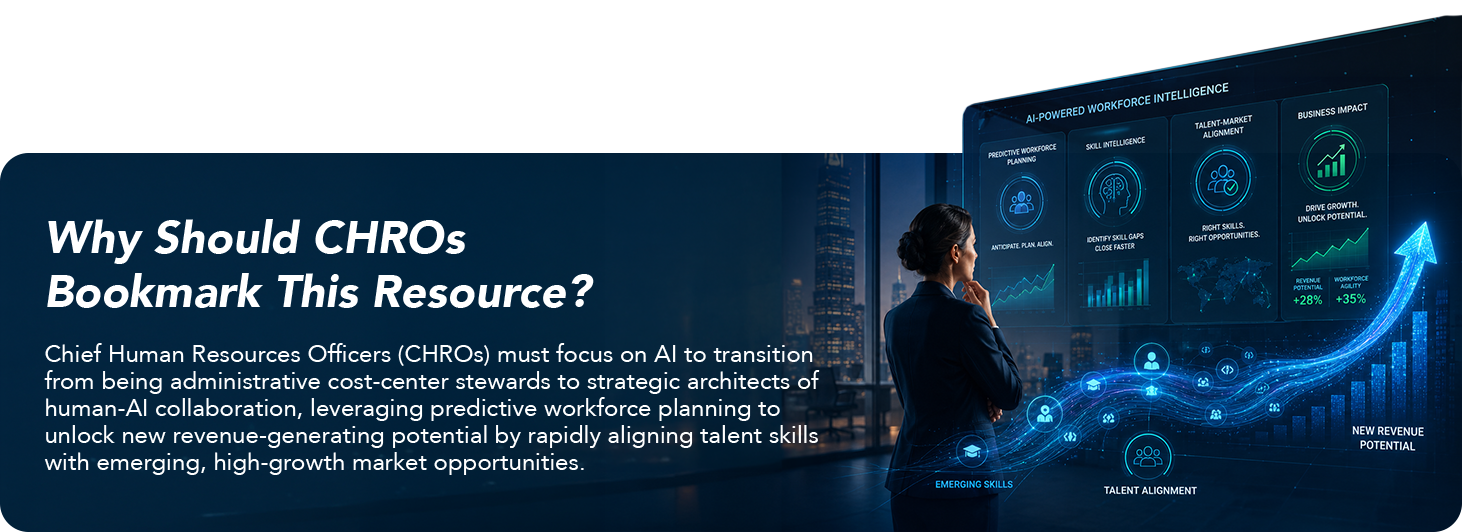
85% fight HR AI readiness solo. Get platform comparisons, fairness playbooks, and retention accelerators that turn HR into a revenue engine.
Leading a modern workforce through rapid technological transformation requires authoritative, actionable strategic blueprints rather than generic management theories or vendor pitch decks. Over eighty-five percent of chief human resources officers navigate AI integration, workforce restructuring, and compliance pressures in isolation, sifting through conflicting software claims while trying to protect corporate culture. This platform serves as your definitive strategic command center, delivering battle-tested CHRO playbooks, objective HR tech evaluations, algorithmic fairness frameworks, and board-ready ROI models. Designed specifically for enterprise executive leadership, our content cuts through hype to deliver high-yield operational guidance that empowers you to transform HR into an active revenue driver. Bookmark this portal now to equip your leadership team with the governance, analytics, and talent accelerators needed to dominate your market while competitors remain bogged down in operational chaos.